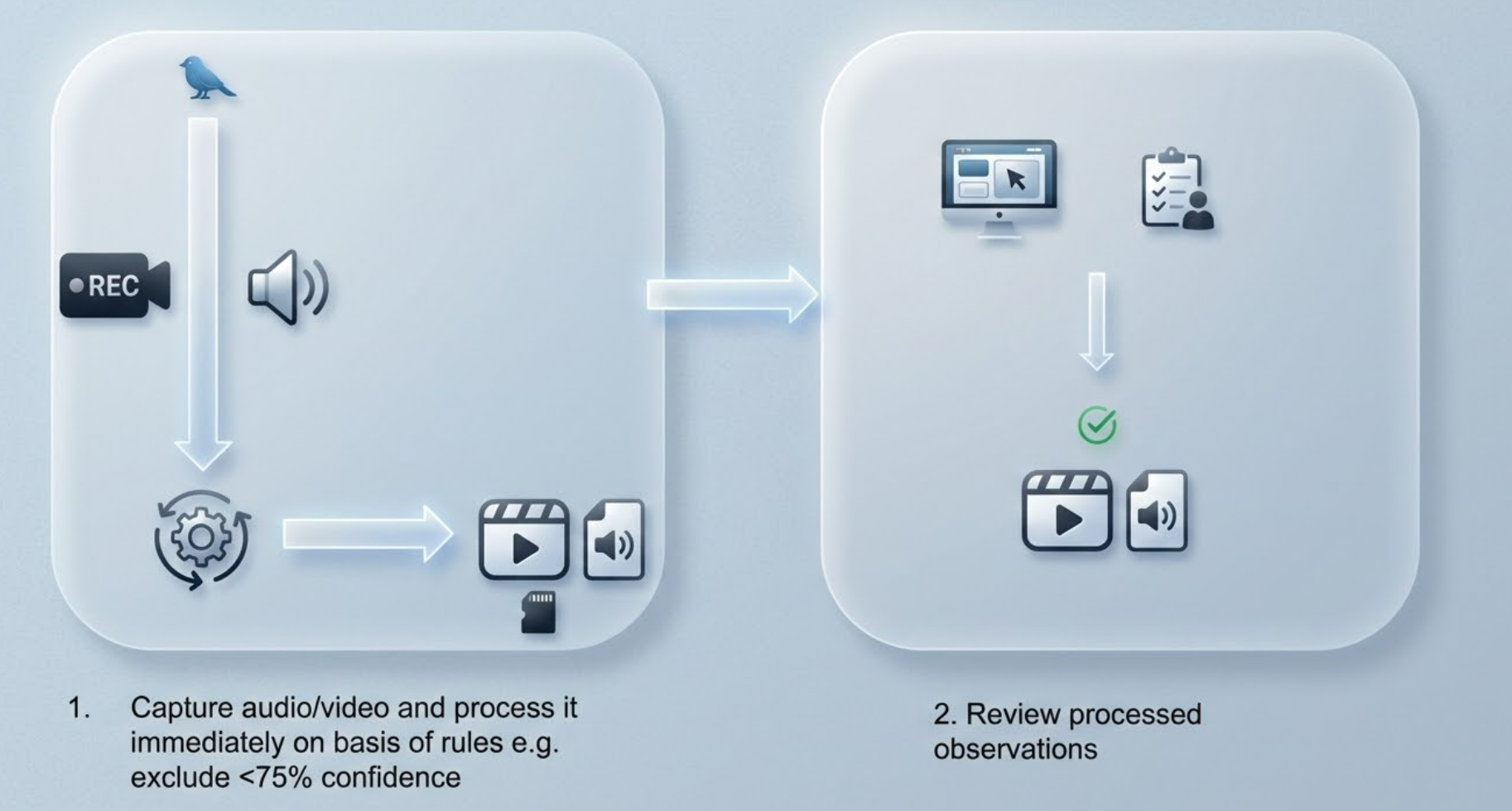
When it comes to handling field observations devices adopt one of these two strategies:
This covers most of the recorders today. These systems have minimum hardware to capture audio or video on a fixed schedule.
Every few days or weeks, someone must retrieve the device, download gigabytes of raw data, and process on a computer.
These are more advanced systems — they don't just record but they also process on-site.
Audio and video are processed directly in the field, with only relevant detections uploaded for review.
There is no manual effort required and information is available as soon as it is uploaded.
| Record and process batch later | Continuous recording-and-processing | |
|---|---|---|
| Setup | Different providers for parabola, recorder, processing hardware & nocmig software | Plug-and-play - works out of the (one) box |
| Cost & power supply | Simple low-power recorders - cheaper | Smarter power-hungry devices, cost slightly more |
| When you see results | Days or weeks later | In near real time |
| Device storage limitations | Raw recordings fill memory card quickly | Store short detection clips only |
| Effort required | Transfer large files from memory card, wait for bulk processing | Automatic, instant transfer, zero wait for processing |
| Manage network of devices | Handle data from each device individually | Automatic consolidation of data centrally on server |
| Data & observations | On laptops/PCs where data is processed, limited accessibility | Online, accessible to all team members |
Noctaves enables ways of working that are not possible with "record now, process later" systems.
Sometimes recording isn't enough — you need to see what's happening now.
Whether it's:
Noctaves turns passive recording into live observations.
Running a station for a few weeks is easy. Running it for months or years is where projects usually fail.
Noctaves supports true long-term monitoring by:
That's how short studies become real datasets.
Many projects don't use one location — they use many.
With Noctaves:
One system. One dataset. No fragmentation.
Devices fail. Cards fill up. Power drops. With traditional setups, you only find out after the damage is done.
Noctaves:
Because the worst kind of data loss is the kind you don't notice.
Message us.