Of all the birds our microphone picked up over Antikythira this spring, the European Bee-eater was the most abundant — better than a fifth of everything we logged. Which almost makes it the least interesting: no rarity, no twitch, just the commonest voice in the sky. But that is exactly what makes it useful. You don't measure the pulse of migration with a scarce bird you might catch once a season. You measure it with an abundant, noisy, unmissable one — a species that calls as it flies and passes in numbers. The Bee-eater is a bellwether. When it moves, you hear the season turn.
For the peak months, the bird behaved exactly as the books promise. Spring passage dominated utterly — the overwhelming bulk of the season's records fell in April and May, in pulses of birds riding good days north.(The bars count occurrences, not individual birds: a run of calls spaced less than thirty seconds apart is treated as one occurrence, so a single noisy flock passing overhead registers once, not fifty times.) There was a quieter surprise folded into it, too: some of those birds were calling at night, in flight, over the sea — a bird we think of as strictly a creature of daylight. (That's a story of its own, for another post.)
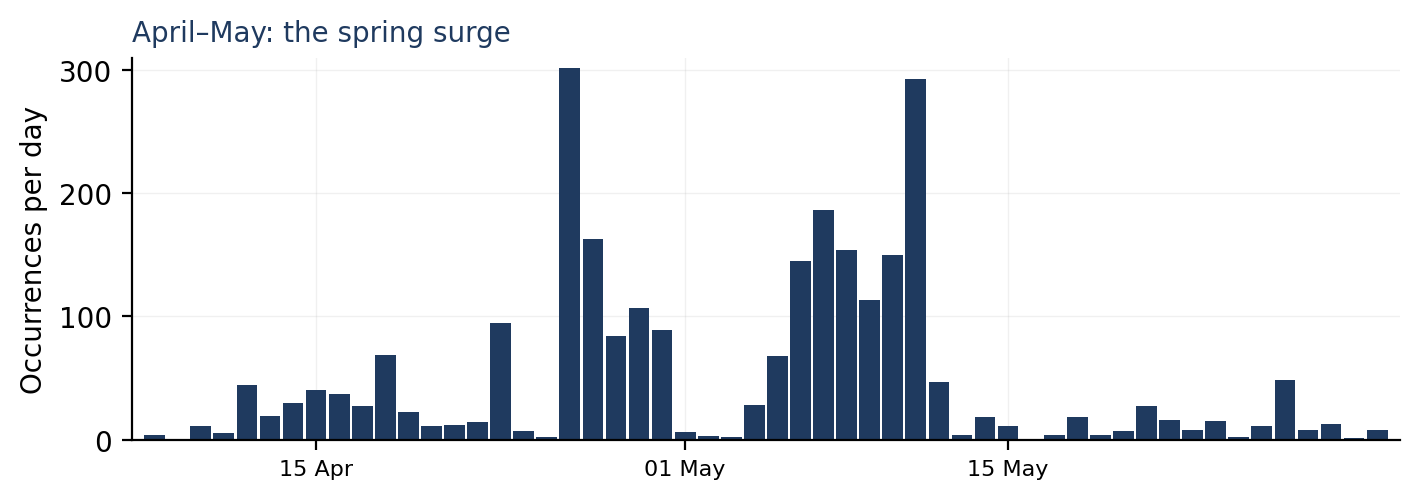
Then it should have gone quiet. June half-obliged: the volume fell to roughly a fifth of May's. Passage was clearly winding down — sort of what you'd expect, except the birds kept appearing on nearly as many days as in May, just far fewer of them. July was the part we didn't expect at all. The flyway should have been empty, and instead Bee-eaters kept turning up — on ten of the month's twenty-one monitored days, the last as late as 21 July, in a thin scatter with gaps of up to five days between them.
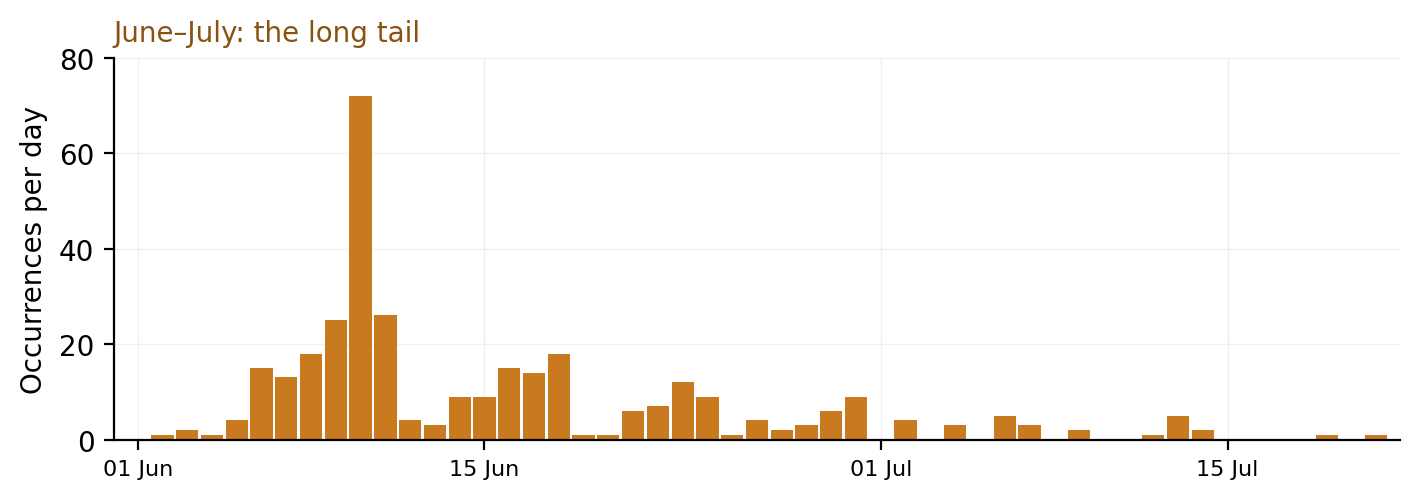
Almost certainly not breeders. Antikythira is a barren rock, and it hosts a colony of Eleonora's Falcons, which take Bee-eaters among their prey — no place to settle and raise young. A resident pair would pass overhead all day; instead we get one brief burst of calls every day or two. The likelier answer is roamers: non-breeding wanderers with nowhere in particular to be, drifting through long after the main flood has gone — and perhaps, in the very last of them, the first faint edge of autumn. Migration, it turns out, doesn't switch cleanly from one season to the next. There's a long blurry middle, and if you keep listening through it, you find it isn't empty. Which is one more reason to look forward to having the unit up and running again next year. A single season raises the question; a second one — same island, same patient microphone — is how we start to answer it.
Message us.
 Noctaves